About Rotary Microtome Semi Automatic
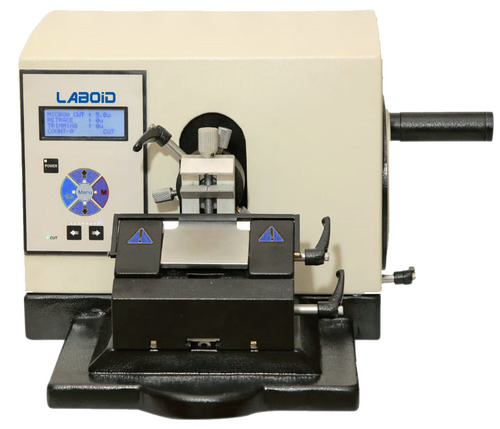
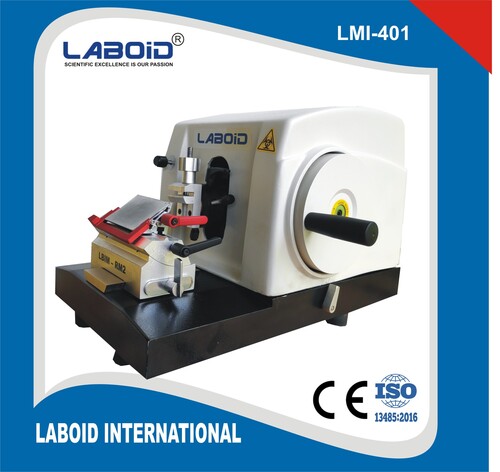
The Rotary Microtome Semi Automatic is a manually controlled cutting equipment used in biology medicine and industry for all forms of paraffin and hard cutting technology operations Its used to prepare microscopic specimens for later lighting Simple operation safety and high precision specimen feed as well as consistent performance ensure high quality sectioning results Rotary Microtome Semi Automatic is tested under various parameters to ensure its high quality and effectiveness All of the major controls are easily accessible and placed in a handy location The display board is used for operations
Technical Specification
Total section thickness range from 05 m to 100m
- Specimen retraction during return travel 0200m selectable
- Motorized Operation Varying with section speed
- Horizontal specimen feed Approx 30mm
- Vertical specimen feed Approx 60mm
- Sectioning Modes 1 Manual Mode
- Specimen Orientation Horizontal 8 degree Vertical 8degree Z 360degree
- Object feed 28mm
- Max Specimen size 50 x 50mm
Superior Precision and DurabilityCrafted from robust stainless steel, the Rotary Microtome Semi Automatic offers exceptional durability and resistance to corrosion. Its precise cutting mechanism ensures consistently thin tissue sections, enhancing the reliability of laboratory results. The semi-automatic function also reduces manual effort, benefiting users by increasing both accuracy and efficiency.
Adaptable for Various Laboratory NeedsThis rotary microtome operates on an electric power source compatible with 50-60 Hz frequency, making it versatile for different laboratory environments in India. Its automatic operation grade and user-friendly design contribute to seamless workflow integration, suitable for research, clinical, and educational laboratories.
FAQ's of Rotary Microtome Semi Automatic:
Q: How does the semi-automatic rotary microtome function in laboratory settings?
A: The semi-automatic rotary microtome uses an electric power source to precisely slice tissue samples. Its semi-automatic operation reduces manual intervention, allowing laboratory technicians to achieve uniform slices efficiently for various analytical purposes.
Q: What are the benefits of using a stainless steel, semi-automatic microtome?
A: Stainless steel construction provides durability and corrosion resistance, prolonging instrument life. The semi-automatic feature enhances accuracy and repeats consistency, while reducing user fatigue and operation time during frequent sectioning tasks.
Q: When is it essential to use a rotary microtome in a laboratory?
A: A rotary microtome is essential when laboratories require precise and thin sections of biological tissue, particularly for histological or pathological examination. It is commonly used in research, medical, and educational laboratories.
Q: Where can I purchase or source the Rotary Microtome Semi Automatic in India?
A: This product is widely available through leading manufacturers, suppliers, dealers, distributors, exporters, fabricators, traders, and wholesalers across India. You can contact local laboratory equipment suppliers or search online for authorized distributors.
Q: What is the process for operating this semi-automatic microtome?
A: To operate, plug the microtome into an appropriate power outlet and prepare the tissue sample. Adjust settings according to your sectioning requirements. The semi-automatic mechanism advances and cuts the tissue uniformly, while you monitor and control the process as needed.
Q: What usage scenarios is this device ideal for?
A: It is ideal for routine and research laboratories involved in sample preparation for microscopic analysis, particularly in hospitals, universities, diagnostic centers, and research institutions focusing on biology, medicine, and pathology.
Q: How does automating the sectioning process improve laboratory workflow?
A: Automation ensures uniform section thickness, reduces manual error, and boosts productivity by allowing staff to handle multiple tasks concurrently. This leads to higher throughput and better overall workflow efficiency in the laboratory.



 Send Inquiry




 Send Inquiry
 Send Inquiry
 Send SMS


